Hearing Protection
Request a quote for otoplasticsHearing Protection
Request a quote for otoplasticsHearing protection is essential
Loud and prolonged noise causes irreversible damage to the hair cells in the cochlea. The result? Hearing loss, tinnitus and hypersensitivity to sound. Noise also often leads to stress, fatigue and concentration problems. Employers therefore have not only a moral but often also a legal obligation to protect their employees. The most logical choice is durable, custom-made hearing protection: otoplastics, which perfectly combine comfort and safety.
Otoplastics: the best choice
Otoplastics are the standard: safe, comfortable and durable. A perfect fit thanks to 3D technology ensures that they are worn longer and more consistently. Tympro's special filters ensure optimal speech comprehension and spatial awareness.
Otoplastics are also the most economical choice: their long service life, lower waste and higher productivity make them better not only for your employees, but also for your business.

Quality & proactive service
Tailored expertise
Platform-driven
Quality & proactive service
Tailored expertise
Platform-driven
Tympro Sound Safe
Our standard set of custom-made earplugs in acrylic. The permeable tube filter offers the following advantages:
- Natural and undistorted sound transmission: sense of space and clear speech intelligibility
- Adjustable damping: always adaptable to changing situations!
- Maximum ventilation and moisture removal

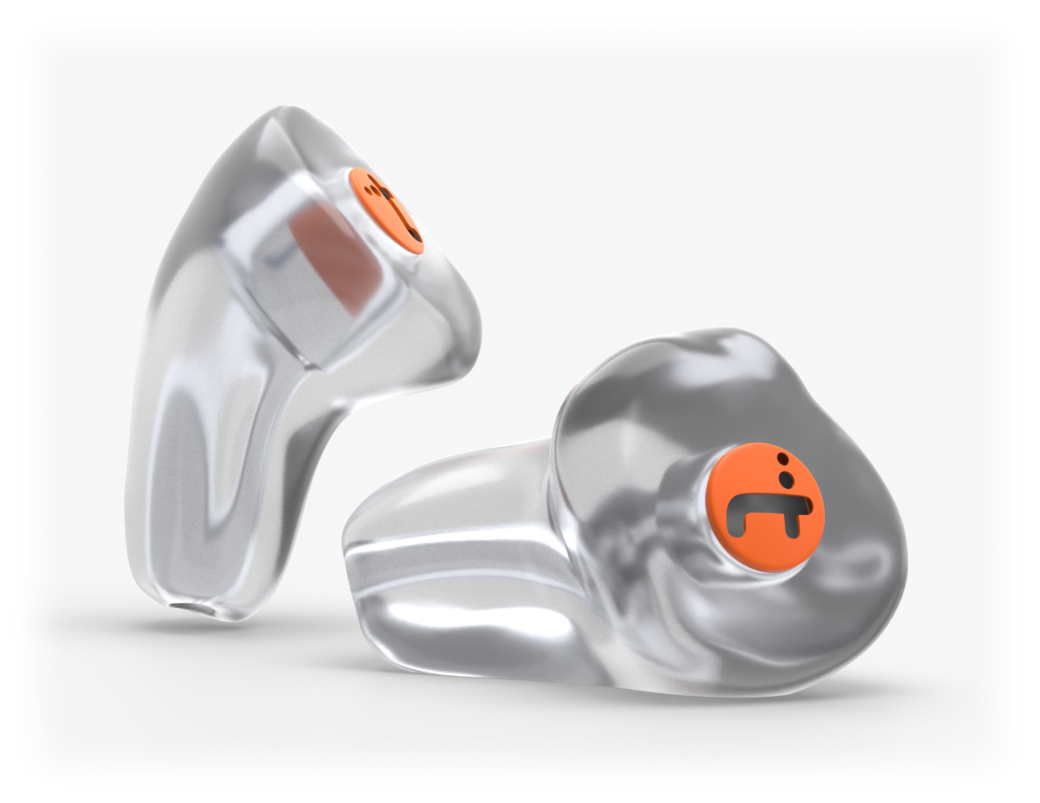
Tympro Orange
Our set of custom-made silicone earplugs equipped with a membrane and mesh filter with the following features:
- Sound filtering with a focus on sound clarity, speech intelligibility and a sense of spatiality
- Fixed sound attenuation of 20 dB, 25 dB or 30 dB
- Ventilation and moisture removal thanks to the filter's breathable properties
Tympro Food
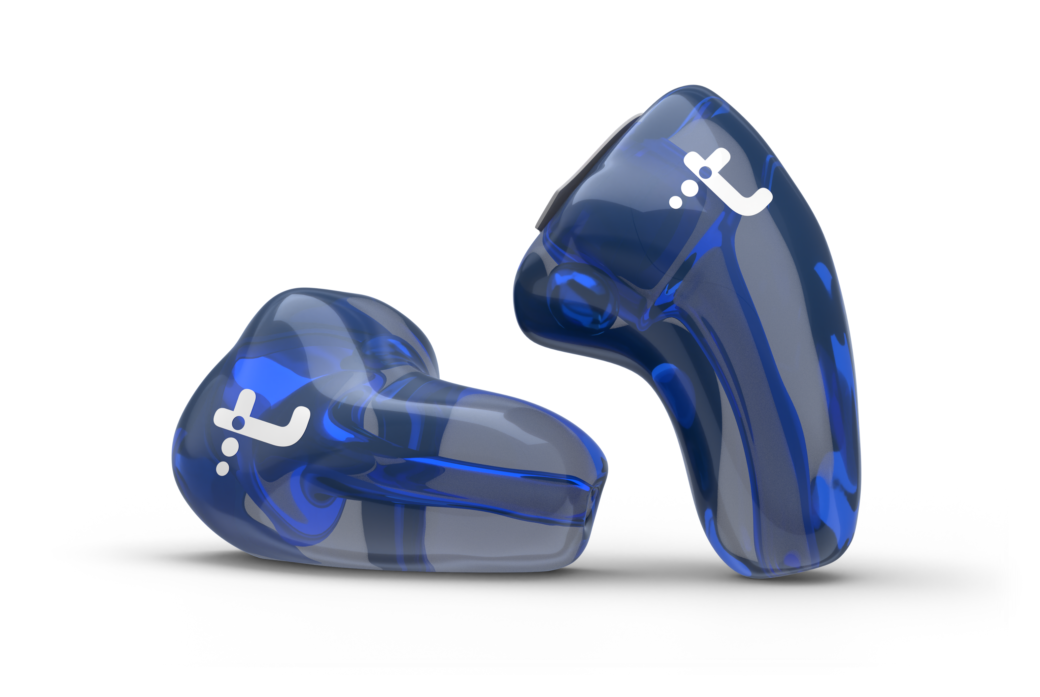
To guarantee food safety, food companies can use a variant of the Tympro Sound Safe: the Tympro Food.
- Acrylic: easiest to clean
- Blue version
- Detectable bullet
- Detectable blue cord
Tympro Impact Coyote
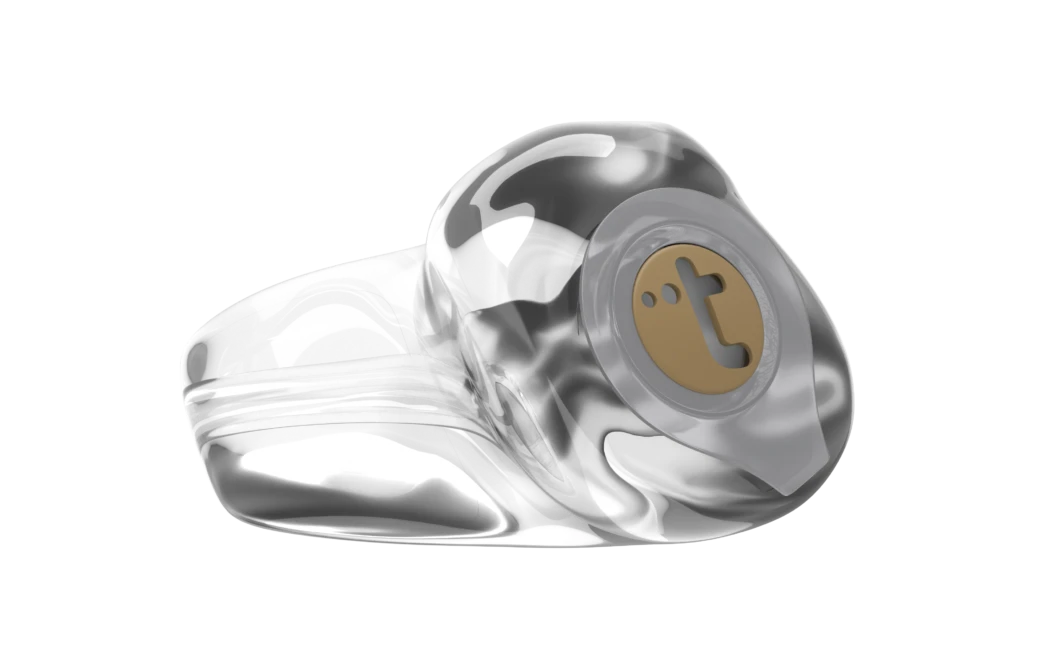
Earplugs for anyone exposed to impulse noise: sudden and enormous increases in sound energy that occur when objects collide violently with each other. Ideal for people working in the construction, metalworking and safety services sectors.
- The impact filter provides extra protection against impulse noises
- Ambient noise is filtered by default while maintaining communication and spatiality
- The Impact Switch filter (optional): a manual switch for additional continuous damping
A cord with a unique design
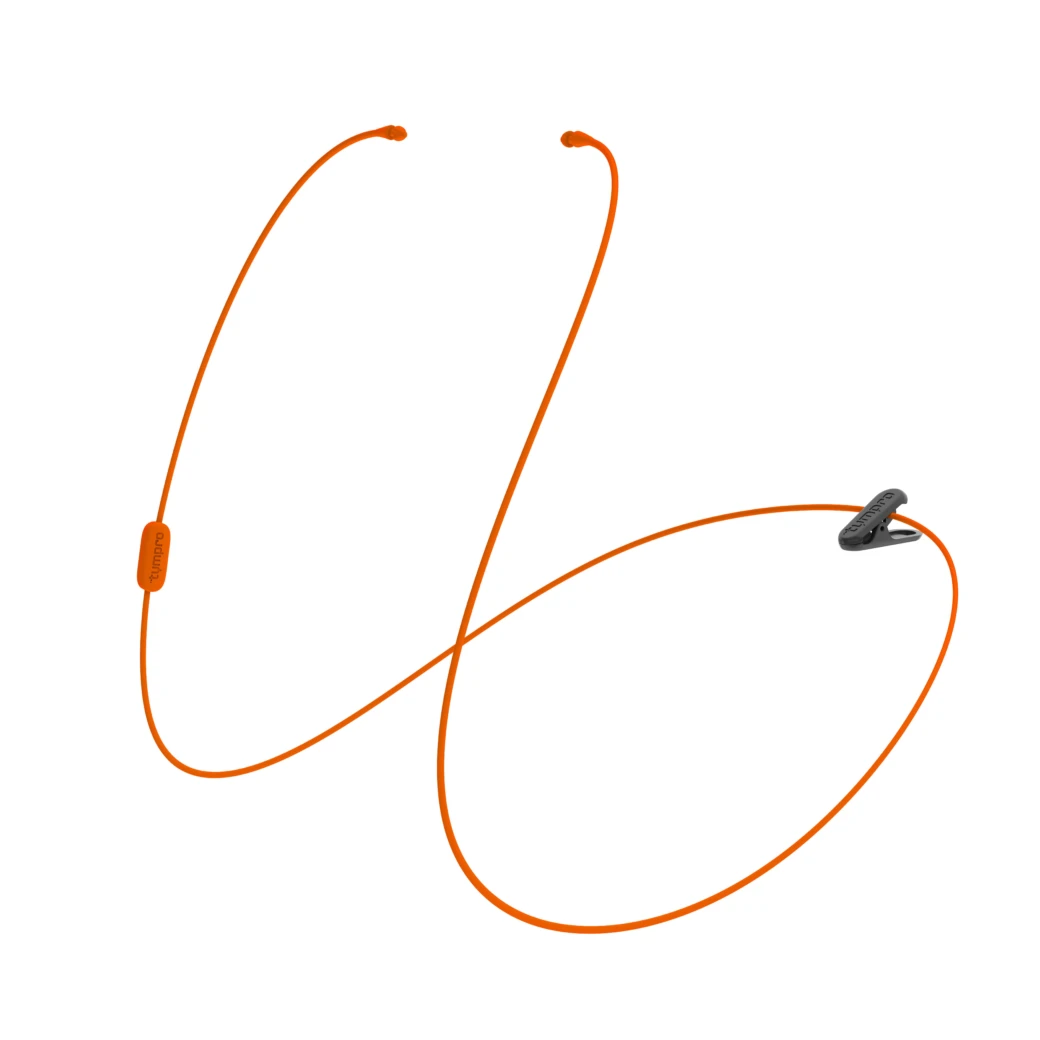
- Keep your otoplastics securely hanging on your chest when entering quiet areas
- The user can easily attach the cord themselves
- Thickening on the right for a tactile and visual check for correct positioning
Our service knows no boundaries
The customer and our office staff will decide when our regional product specialist will visit to take ear impressions. Three weeks after the impressions are taken, we can deliver the custom-made hearing protection. Clear instructions are provided and leak tests are carried out. After that, we are always available to make any necessary adjustments. Tympro will then proactively contact you annually to schedule maintenance. Our audiologists are always available for specialist advice.
Quality across the board
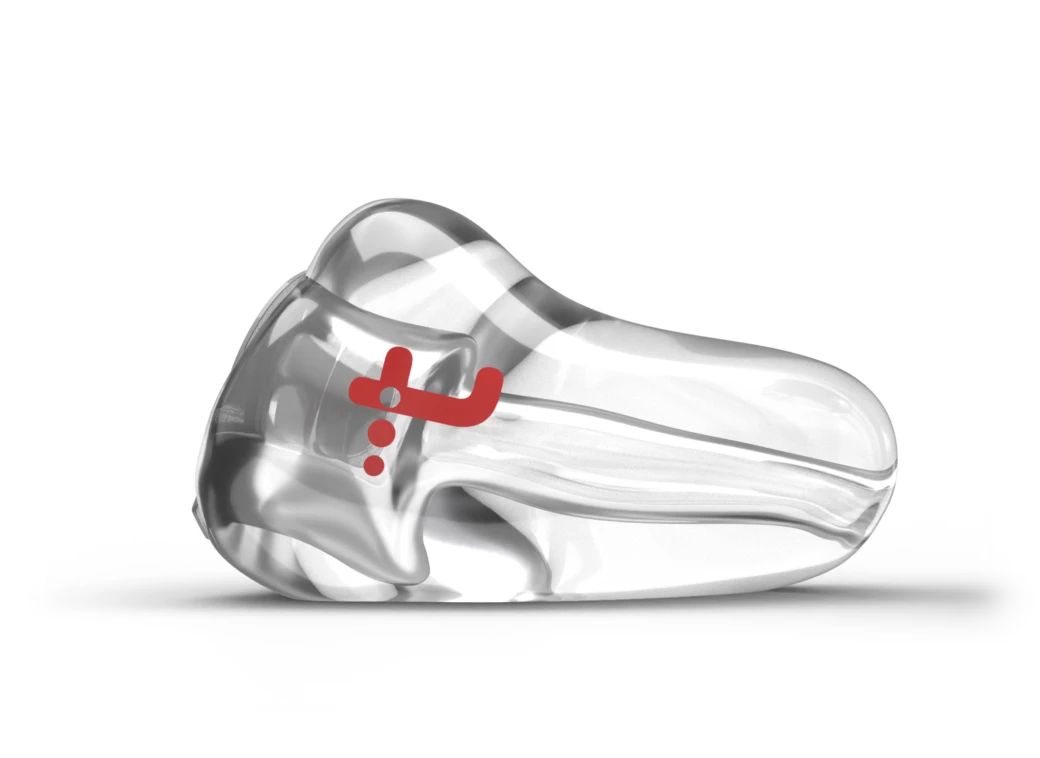
The perfect fit offers the greatest comfort and safety. Tympro monitors every step of the process for quality to achieve this perfection.
- Intensive repeated ear impression training
- Latest 3D technology supported by AI
- Fit analysis and leak test upon delivery
- Otoplastics certified according to EN 352-2
- Business process certified according to ISO 9001
Maintenance for optimal protection
Because the shape of your ear changes constantly, otoplastics will no longer fit perfectly over time. This can lead to unnoticed leakage and hearing damage. In addition, earwax and dirt can affect the attenuation of your hearing protection. Annual maintenance is therefore essential.
- A 6-minute on-site consultation per user
- The user shares his experience with the earplugs
- External and internal cleaning of the otoplastics
- Replacement of the noise filter and reset of the attenuation
- A leak test determines whether replacement is necessary
Maximum hygiene for your ears
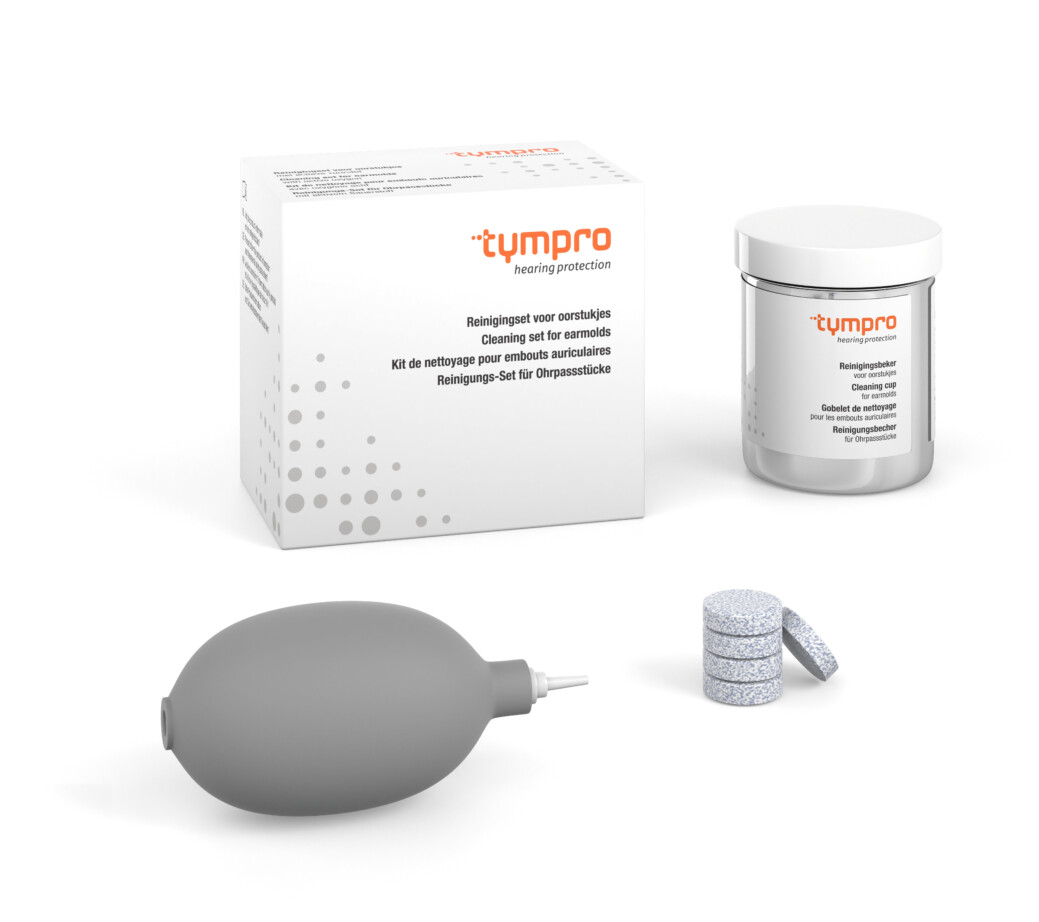
Prevent infections or other problems by keeping your customised hearing protection clean. Tympro offers several solutions for this:
- Cleaning wipes, storage pouch & cerumen removal tool (included)
- Cleaning kit: small container, cleaning tablets & bellows
Safe and reachable
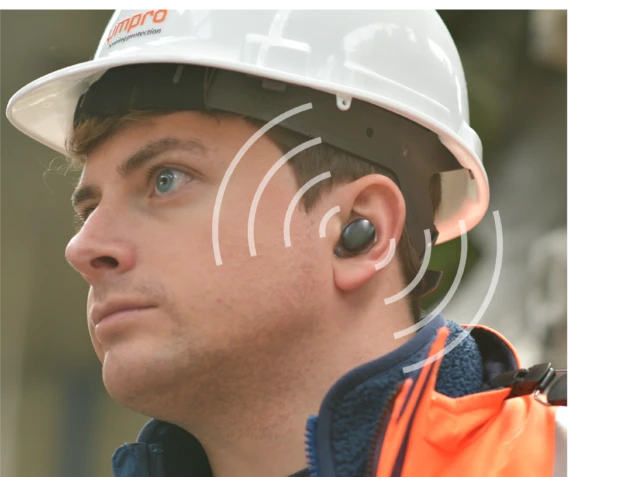
Communication with colleagues is essential in the workplace. Unfortunately, background noise makes this challenging. Tympro provides communication tools that are compatible with its ear moulds. This enables clear and safe communication even in noisy environments.
First analysis, earplugs second
Hearing protection is part of a larger whole. Tympro takes over the entire noise management process for its customers and offers the following services:
- Noise measurement via dosimetry
- Hearing examination via audiometry
- Awareness raising via toolbox meetings
Protected during leisure time as well
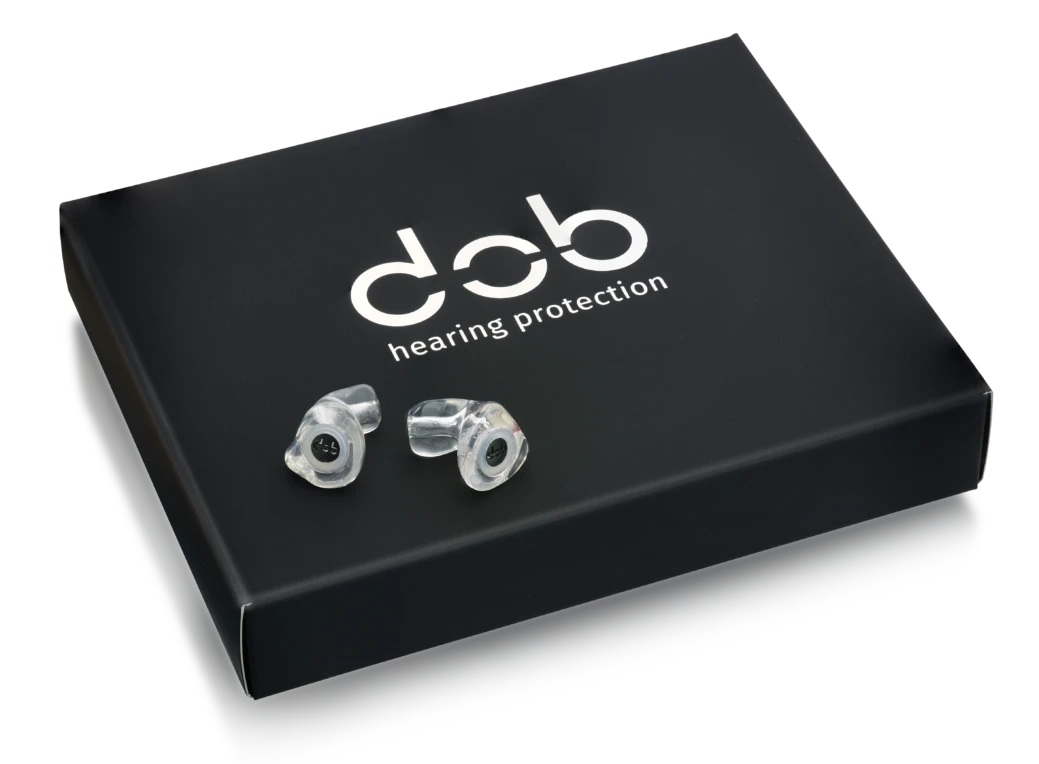
Tympro also offers hearing protection for private individuals: earplugs from dOb. The range includes both reusable and customised earplugs with sound filters for the applications listed below. If we have already made impressions of your ears, you can easily reorder dOb earplugs via the reorder web page.
- Listening to music without distortion
- Comfortable and protected DIY
- Sleep or concentrate without disturbance
- Swimming with dry ears
Get information from our experts
Would you like us to assist you personally in choosing hearing protection and accessories, or to explain clearly what our service entails and how we can tailor it to your company's needs? We will be happy to send you the relevant information, talk to you without obligation, or visit you at your premises if you wish.
Frequently asked questions about our hearing protection and our service
On average, otoplastics last for 5 years. Because the outer ear changes differently and at different rates for everyone, the individual lifespan can vary greatly from person to person.
That is why we recommend performing an annual leak test instead of replacing the otoplastics after a fixed number of years. This has two major advantages:
- Safety: You prevent someone from walking around with leaking earplugs for years (false sense of security).
- Cost savings: You only replace the otoplastics when they really no longer seal properly, and not unnecessarily early.
We provide custom-made hearing protection in six steps.
- Contact & assessment: You contact us. We will assess your specific requirements, the number of users and your preferences.
- Quotation: Based on this conversation, you will receive a suitable quotation.
- Planning: After you have agreed and completed the customer form, we will schedule an appointment with our product specialist in consultation with you.
- On-site measuring: Our specialist will visit you. He can measure approximately 10 people per hour.
- Production: The ear impressions are processed into otoplastics in our laboratory.
- Delivery with leak test: We will return within four weeks of the initial assessment to deliver the sets. We will provide instructions and perform a leak test to guarantee 100% safety.
The maintenance session will be completely useless without the users. The most important part of the maintenance is the leakproof test. During this test, the product specialist tests whether the otoplastics still blocks the ear canals adequately. In addition to this, the dialogue between the user and the product specialist is very important. Based on the experience, adjustments, such as the damping, can be made.
The product specialist delivers the otoplastics on site. Upon delivery, an instruction is given and the otoplastics are tested for leak-tightness. If the otoplastics show a leak, new ear impressions can be taken immediately. The user can also immediately indicate whether the otoplastics feel good or not. The specialist also supports the user in the exercise to insert the otoplastics properly. We therefore strongly recommend a presence of the users. Suppose someone is unexpectedly absent, we leave the otoplastics set up and test them during another appointment.
The choice between hard and soft otoplastics depends on the working environment, hygiene requirements and personal preference.
Hard otoplastics (acrylate): These are made from a hard, durable plastic.
- Superior hygiene: Due to their smooth surface, dirt, earwax and bacteria hardly adhere to them. They are very quick and easy to wipe clean. Due to their high cleanability, hard otoplastics are preferred in the food sector.
- Easy insertion: Because the material is smooth, they slide effortlessly into the ear. This is ideal for employees who frequently need to insert and remove their hearing protection (e.g. managers).
- Fit & movement: Because the material is rigid, it does not bend. If you talk or chew a lot, it can sometimes feel uncomfortable and a tiny gap can sometimes form, allowing sound to leak in.
- Durability: Hard ones are less prone to normal wear and tear, making them the most durable, but they can crack or break more easily if dropped on a hard concrete floor.
Soft otoplastics (silicone): These are made from flexible silicone material.
- Maximum comfort: The material is soft and flexible. This reduces the risk of pressure points or irritation in the ear canal, making them ideal for long shifts.
- Constant protection: Because silicone is flexible, it moves with the ear canal. Even when you talk, laugh or chew, the seal remains intact.
- Comfort and safety under the helmet: Soft material is more comfortable and safer for wearers of safety helmets. In the event of a blow to the head, the material gives way instead of passing the impact on to the ear.
- Slightly more difficult to use: Silicone has more friction: it does not slide over the skin. Insertion sometimes requires a twisting motion, and it can attract dust more quickly if touched with dirty hands.
- Slightly smaller occlusion effect: Because silicone is flexible and has a lower density than hard acrylic, it absorbs vibrations from the ear canal wall better. This often makes your own voice sound more natural and less muffled.
- Durability: Soft otoplastics wear out a bit faster and don't last as long. They also tend to discolour over time. But they're more shock-resistant and pretty much indestructible if dropped. They bounce instead of breaking.
In summary:
- Choose hard if hygiene is crucial (food), if the earplugs need to be inserted and removed very often, and if they need to last as long as possible (durability).
- Choose soft for maximum comfort during long days, when talking/moving a lot, or in heavy industry/construction where a helmet is worn.
Applying a standard replacement period (e.g. every 5 years) for otoplastics is neither the safest nor the most cost-effective strategy.
This is because the outer ear changes in a unique way and at a unique speed for each individual. As a result, the actual lifespan of otoplastics varies greatly from person to person.
The risks of a fixed replacement period are twofold:
- Risk of hearing damage (false sense of security): In some users, the ear canal changes more quickly, which means that otoplastics can start to leak after only two years, for example. If they are not replaced until after five years, the employee will have been walking around with a false sense of security for three years, which can lead to irreversible hearing damage.
- Unnecessary costs (waste): For other users, the fit remains good for much longer (e.g. 8 years). If these otoplastics are discarded preventively after 5 years, the company incurs unnecessary costs for replacement that was not yet necessary.
What is the best alternative to a fixed replacement?
Instead of blindly relying on a calendar year, annual checks are the gold standard.
- Annual leak test: By testing earplugs for leaks every year, you can be sure that they still provide adequate protection. Leaky earplugs are replaced immediately, while earplugs that are still in good condition remain in use.
- Maintenance and dialogue: A maintenance appointment provides an important opportunity for contact between the specialist and the wearer. Any complaints, comfort or hygiene issues can be resolved immediately. The filter is replaced and the earplug channel is cleared, eliminating any excessive attenuation. This has a positive impact on wear acceptance.
The otoplastics are delivered within 4 weeks after the time of measurement. Tympro takes care of the delivery itself, whereby the specialist gives personal instructions to the new user and performs a leak-tightness test on the otoplastics. The leak tightness test is only possible if the user is present, as the otoplastics are tested in the ears.
Strict rules apply in both the Netherlands and Belgium (based on European Directive 2003/10/EC). There is a simple rule of thumb: from 80 decibels, only the employer needs to take action, and from 85 decibels, the employee must also take action.
1. The lower action values
As soon as the average noise level over an 8-hour working day (LEX,8h) reaches 80 dB(A), or there are peak observations of 135 dB(C), the following obligations apply:
- Employer: Legally obliged to provide hearing protection (such as earplugs) to employees.
- Employee: Not required to wear protective gear, but it is strongly recommended.
- Prevention: The employer must provide information about the risks and offer employees the opportunity to undergo an audiometric examination (hearing test).
2. The upper action values
This is the critical point. If the daily dose (LEX,8h) averages 85 dB(A) or higher, or if there are peak noises of 137 dB(C), the following rules apply (in addition to the rules that already applied above).
- Mandatory wearing: Wearing hearing protection is now a legal requirement for employees.
- Enforcement: The employer is obliged to monitor usage (enforce). Simply “offering” is no longer sufficient.
- Marking: Workplaces where this limit is exceeded must be marked with pictograms and, where possible, cordoned off.
- Action plan: The employer must draw up an action plan to reduce noise at source (technical or organisational measures).
3. The limit values
There is an absolute maximum average daily dose of 87 dB(A) or peak noise levels above or equal to 140 dB(C). The attenuating effect of hearing protection may be taken into account for these values.
- Rule: The average noise level in the ear (i.e. under the protector) must never exceed 87 dB(A). If this is exceeded, work must be stopped immediately so that measures can be taken to reduce exposure. The causes of the exposure must also be identified and measures adapted to prevent recurrence.
Applicable regulations:
- The Netherlands: Working Conditions Decree Chapter 6, Section 3 (Noise)
- Belgium: Codex on well-being at work, Book V, Title 2 (Noise)
In the food industry, food safety is the highest priority. Hearing protection must therefore not only protect hearing, but also eliminate the risk of physical contamination (foreign particles in the food). To comply with strict quality standards such as HACCP, IFS and BRCGS, hearing protection must meet four crucial requirements:
- Metal detection (traceability): In the unlikely event that an otoplastic falls into the production line, it must be detected immediately by the detection systems. Standard plastic is not detected by metal detectors. That is why a steel ball is incorporated into the design. This ensures that the final check (the metal detector) stops the line if the earplug ends up in the product.
- Visual detection (use of colour): Blue is a colour that does not occur naturally in foodstuffs. For this reason, blue is the industry standard. This ensures maximum contrast, allowing employees or visual inspection systems to immediately detect a lost ear mould on the conveyor belt or in the product.
- Hygienic material (recommendation: acrylic): In environments where bacteriological risks must be minimised, Tympro recommends the use of hard acrylic.
- Why acrylic? Unlike softer silicone materials (which can be more porous and age more quickly), acrylic has a smooth, hard and non-porous surface.
- Cleaning: This makes the otoplastics very easy to clean and disinfect, which is essential to prevent cross-contamination. Acrylic is therefore the most hygienic choice for the food industry.
- Anchoring (cord with clip): Prevention is better than detection. That is why we always recommend using a cord with a clip. This prevents an otoplastic from falling on the floor or into a machine if it slips out of the ear.
- Specifications: This cord must also meet the detection requirements: it must be blue and contain detectable material (such as metal particles).
When determining the damping values, first and foremost, the protective base is taken into account. This is determined based on the sound levels in the company. We base this on noise reports prepared in the past by us or by another party. If there are no measurements of this, we will make an estimate based on the industry and activities. Secondly, the avoidance of overprotection (too large attenuation value) is always taken into account, which in itself leads to higher acceptance of the hearing protection, which is of course beneficial for hearing health. The manageable attenuation values of otoplastics have an adjustment range between 20 dB and 35 dB.
The auditory canal has a self-cleaning mechanism whereby earwax is expelled naturally. In some people, this process regularly goes wrong and earwax continues to accumulate, causing a hardened cerumen plug.
A clogged ear is an important reason for not having a fitting. If the product specialist wishes to insert a cotton wool and inject mould paste into the ear canal, there is a risk that the hard and sometimes sharp cerumen plug will be pushed in even further and damage the eardrum. In addition, the ear impression will not be representative enough to make a good otoplastic from it.
If Tympro will visit soon to take ear impressions, it is advisable for people who regularly have cerumen plugs to visit their GP (just) before the appointment to remove the cerumen plug. Otherwise, there is a risk that the staff member and the product specialist will have to make a second fitting appointment with each other. So keep each other well informed about Tympro fitting times.
Customised earplugs, also known as otoplastics, are personal hearing protectors that follow the exact shape of your ear canal. Because they are produced specifically for your ears, they offer optimal sealing and the highest possible wearing comfort without pressure points. These properties make otoplastics superior to universal earplugs. Our approach combines craftsmanship with innovative 3D technology:
- Ear impression or ear scan: A specialist will make an exact impression of your ear using silicone material or create a digital 'impression' using an ear scanner.
- 3D production: In the case of a physical impression, the ear impression is digitally scanned and then modelled using software. In the case of an ear scan, the 3D file of the ear is transferred to the software for direct modelling. We then print the earplug with extreme precision in hard acrylic or soft silicone.
- Filter placement: The earplugs are fitted with a professional filter. This filter is designed to attenuate harmful noise while allowing speech and warning signals to remain audible.